Total Pageviews

Friday, June 3, 2011

Strut Ends

Cut-away view of early strut design.
The struts are used to suspend the pallet from the forward bulkhead of the Orion capsule.  To the left is one of the very early (aluminum!) conceptual models for the adjustable struts.  Pay special attention to the cutaway section showing the interior of the strut.

The figure below shows the schematic of one of the short vertical struts in its final design form.  Note how the ball joint rod end is welded into place after the threads have been drilled out an a lead screw has been inserted.  This is then welded to the round plate at the end of the strut.  Welded to the plate is a guide bushing to support the lead screw.  A hex nut is then welded to the guide bushing.  This design allows the length of the struts to be adjusted as needed.  The manufactured parts for these strut ends, made by Jim Mills, are shown directly below the schematic.


Dimensioned schematic of a vertical strut with manufacturing instructions included.
Ball joint, threaded rod, end plate, guide bushing, and lead screw hex nut used to form each end of the struts.

Positioning of the end plate on the welding workstation to allow the guide bushing and hex nut to be welded into place.

Close-up of the strut end, after welding has been completed.

Strut ends, arranged on the welding workstation.
The figure below shows the strut ends on two completed struts, laying on the pallet.  The next figure shows two completed struts, with the ball joint ends screwed completely in.  It is interesting to take note of their size in relation to the pallet.  The struts for different positions on the pallet are of different length, so not all struts will be this long.

Ends of two completed struts.

Two completed struts and some of the completed brackets.

Manufacturing the Pallet/Strut Connection Brackets

The schematic for the pallet/strut connection brackets is shown below.  Each bracket is manufactured from three separate metal workpieces:  two square pieces that are machined to form the rounded "ears" and a rectangular base, all cut out of A36 1/4" steel plate.  All three workpieces are welded together to form the final bracket.


Schematic of the pallet/strut connector brackets, drawn by the team.
The picture below shows how Jim Mills is machining three of the bracket "ears" at the same time in the milling machine.  The cutting tool moves in a half-circle to remove the necessary material.  Some of the already completed "ears" can be seen at the bottom of the picture.  The image that follows shows three workpieces welded together to form a single bracket.  Some additional machining and grinding is required before the part is ready for installation.

Machining the pallet/strut connection brackets.
Welded pallet/strut connection brackets.
Finally, compare the brackets above to one of the solid model conceptual design images created by the team in Solid Edge.  All that is left is to drill the holes in the base.

Conceptual model of the pallet/strut connection brackets created in Solid Edge.

Thursday, June 2, 2011

Detail work on the Pallet


Prefab strut corner placed in CNC mill to do the inside chamfers required.

Close-up of the corner with inside chamfers clearly shown.
The pictures above show some of the detail work being done on one of the pallet sections (which has already been welded).  Note the tool (and its shape) used to cut the chamfers for the holes.  According to James Mills, who is responsible for manufacturing the pallet and struts, this was a bit challenging to setup with available equipment.  This part of the work is being done on a Smithy CNC (computer numeric controlled) milling machine. 

The picture below shows one of the pallet sections setup in one of the other milling machines (Atrump vertical milling machine, shown to the left) we have in the Fabrication Laboratory.  Thanks to Jim Mills for providing these pictures!

More detail work on the pallet!
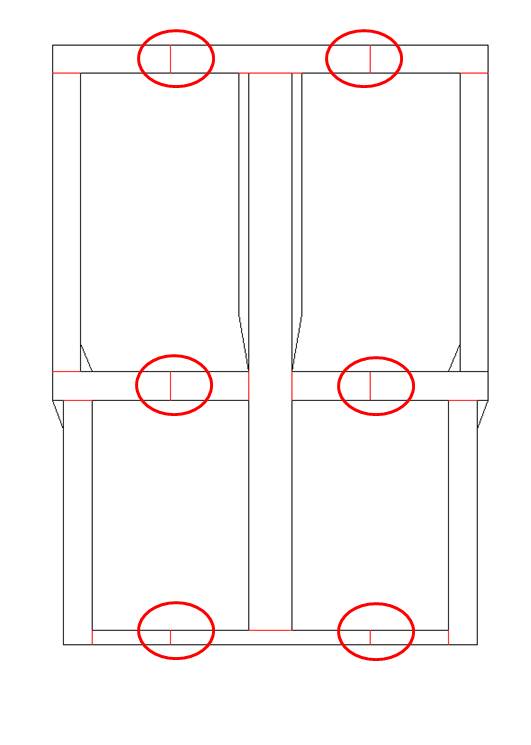
The image below shows why these holes are necessary:  to connect the pallet sections together.  The pallet is divided into three sections that will be assembled INSIDE the Orion capsule mockup on location at NASA.  This is needed for two reasons:  first, the assembled pallet will not fit through the entry hatch; second, the assembled pallet will weight about 600 lbs!  By dividing it into three sections it can fit through the entry hatch and will be easier to position inside the mockup. 

Red ellipses show in the sketch above show the break points for the three pallet sections.


Holes drilled into two of the pallet sections, coinciding with the lower portion of the figure above. Note the chamfers!

Friday, May 27, 2011

Manufacturing Update

Two of the adjustable struts have been completed:

Two of the completed struts, viewed from one end

Struts and pallet
Work in progress!

Tuesday, May 24, 2011

NASA Visits UT Tyler

Jeff Fox, Christie Sauers, and Leland Dysart from NASA Johnson Space Center in Houston visited UT Tyler for an update on the pallet and struts construction, as well as to visit with students from Fruitvale High School who are also working on the medium fidelity Orion mockup.

James Tubb, James Nelson, James Mills, Leland Dysart, and Christie Sauers discuss the pallet design at the UT Tyler Fabrication Laboratory.
Further discussion of the pallet, while UT Tyler team leader James Tubb refers to the project report and drawings.
 
Weld prepared as an example of how the strut ends will be fabricated.
Fruitvale High School representatives and NASA engineers watching a demo of the laser cutter in the UT Tyler Manufacturing Laboratory.
One of the main purposes of the visit was for NASA engineers to take a look at the pallet and address concerns about weight.  The current pallet design weights 495 lbs, not including the struts.  A quick call to JSC verified that the forward bulkhead, from which the pallet with be suspended, had been designed for sufficient strength to support the pallet, struts, training astronauts, and technicians.

NASA engineers also wanted to see examples of the various welds that would be used to hold the pallet together.  UT Tyler engineering dean Dr. James Nelson, who made it possible for UT Tyler and various high schools in East Texas to participate in this project, also advised on the pallet based on his background in structural design.

Friday, May 20, 2011

Special VIP NASA Tour!

The UT Tyler NASA Orion team was invited to Johnson Space Center for a special, behind the scenes tour!
A big  "Thank You!" to Jeff Fox and Christie Sauers!

James Mills, James Tubb, Sara McCaslin, and Whitney Walker at Mission Control!

Monday, May 16, 2011

Practice Welds

Mr. Mills has begun to work on the pallet welding.  The images below show some of the practice welds from last Friday (May 13th).  These are single pass, 18V, 250 ipm (inches per minute) wire feed, 25 cfh (cubic feet per hour) of 75-52 shielding gas.  Top and bottom welds on the pallet will be ground flush tot he surface.


90 degree fillet weld


Side weld 4x6 to 2x6 steel tubing with a 3/16" wall

  
After bead blasting
All cleaned up